I've haven't blogged in a while. The elections are a good time to (possibly) return. To kick things off, here's some light humor. Feel free to post your own in the comments, but nothing nasty.
How many Bayit Yehudi members does it take to change a light bulb?
None - they don't apologize for broken light bulbs.
How many Yesh Atid members does it take to change a light bulb?
Two - one to buy the bulb without VAT, and one to explain why the price of light bulbs hasn't come down.
How many Likud members does it take to change a light bulb?
Only one, but he keeps putting the same one back.
How many Zionist Camp members does it take to change a light bulb?
Two - one to change the bulb, and one to call it something else in Arabic.
How many "Movement" members does it take to change a light bulb?
Two - one to change the bulb, and one to tell you that despite all the burnt-out bulbs, Bibi hasn't changed a single one in the past six years.
How many Meretz members does it take to change a light bulb?
Two - one to change the bulb, and one to complain that the entire budget for light bulbs was given to the Settlements.
How many Yisrael Beitienu members does it take to change a light bulb?
<This punchline is under a gag order until the criminal investigation is completed.>
How many UTJ members does it take to change a light bulb?
Two - one to change the bulb, and one to make sure that a cheder in Bnei Brak gets a new bulb also.
How many Shas members does it take to change a light bulb?
They only have one guy who knows how to change the bulb, but he left a week ago. No wait - he's back now.
How many Ha'am Itanu members does it take to change a light bulb?
Two - one to change the bulb, and one to leak a video of Maran saying that their guy is really the only one who knows how to change the light bulb.
How many Kulanu members does it take to change a light bulb?
None - Kulanu only knows how to fix cellphones.
How many Hadash members does it take to change a light bulb?
One, and he does it on Shabbat because changing a light bulb is pikuah nefesh.
How many Balad members does it take to change a light bulb?
The light bulb has been there since time immemorial. They will not remove the old light bulb from its ancestral land.
How many Kadima members does it take to change a light bulb?
They don't change light bulbs. They "disengage" them from their sockets and don't take any responsibility for what replaces them.
Sunday, January 18, 2015

Monday, January 6, 2014
Testing the Post's Defense
As a tabloid, the New York Post does not shy away from controversies. They're in business to sell newspapers, and printing shocking headlines is standard fare. However, its reporting of a recent sickening murder has many saying that it has gone too far.
 In reporting the gruesome killing of a Hasidic slumlord (well, alleged slumlord, according to his brother-in-law), the Post ran a photo of the victim in Hasidic garb, with the headline, "Who didn't want him dead?". Outrage has been swift - while the Post is well-known for its crass headlines, this seems to be the first time they have justified a murder. Not so far as to excuse it, but showing some understanding for the murderers intent is crossing a pretty big line.
The Post, (as of this writing) instead of issuing an apology, retraction, or making any sort of gesture that maybe the headline went too far, issued a statement to the effect that they're not condoning the murder, just pointing out that the list of those who might have wanted to commit this heinous act is long. True, that's all the words of the headline literally say, but the insinuation that a murder victim was public enemy #1 (after all, who didn't want him dead) goes far beyond pointing out that his list of haters was longer than most's. They might as well have written "Good riddance to bad rubbish!".
Besides the Post, there are many who are saying that it's just a case of "the Post being the Post". According to this line of reasoning, the only reason the Jewish community is up in arms about the headline is because it's happening to one of our own. This is a bit naive, since people often only get up in arms if they identify with a victim. That doesn't mean that their indignation is misplaced.
To test if the Post's (and its defenders') defense holds water, let's change the variables just a bit. If, instead of a Hasidic business man being murdered, a drunk, pretty college girl was raped, would it even cross the minds of the Post's editorial staff to run a crass headline to the effect that, well, the girl invited trouble and there's a list a mile long of guys who would love to have sex with her? If they did run such a headline, would as many people come to the Post's defense?
Monday, December 23, 2013
New trend in terrorism?
 It used to be that anytime there was an explosion on a bus (or other public place), the safe assumption was that it was a suicide bomber (or a mob hit). The past two explosions on buses (one yesterday, and one last year during Operation Pillar of Defense) both proved to have been explosive devices left on buses (and thankfully non-fatal).
Is this a new trend? Are terrorists getting less religious, and therefore less willing to lay down their lives for their causes? Is Israeli security getting better? Maybe it's all a coincidence?
Friday, December 20, 2013
Lies, damned lies, and the Taub Report (Dov Lipman on education)
Last week, MK Dov Lipman addressed the Knesset (video with English subtitles below), announcing that the recently released "Taub Report" ("State of the Nation Report – Society, Economy and Policy 2013") proves that there is no discrimination against Chareidim in the workforce (i.e., in finding jobs), and urging every MK to read the report.

Lipman is a well-educated guy. He has a masters degree from Johns Hopkins university, which, as the poet would say, is not too shabby. However, he does not seem to understand statistics and how to properly interpret them. (An alternatively explanation is that he does understand them, but he's purposely trying to pull off a deceit, a notion I see no reason to even entertain.)
To make his point, he cites the following from the report:
- Among Chareidi men, 71% of those who hold an academic degree find a job, compared with 34% of those without a degree.
- Among Hareidi women, the respective stats are 76% vs. 50%.
- Salaries for Chareidi men with a degree are 80% higher than those for Chareidi men without a degree. (Although Lipman does not mention it, the report lists a similar statistic for women.)
- A couple wherein both spouses have a degree earn 157% more than a couple wherein neither spouse has a degree.
- Of men aged 25-43, fewer than 8% have a degree (800 of the 10,000 men sampled).
- Only 5% have earned a matriculation certificate (which is necessary to enter college)
From this, he concludes that the only way for Chareidim to end the cycle of poverty in their communities is through higher education.

For some reason, his conclusion (education is the key!) had nothing to do with his opening statement about what the statistics show (no discrimination!). Besides that rhetorical oversight, his presentation was unconvincing in several ways.
First of all, the obvious - it's a bit odd for a member of Yesh Atid to preach the importance of higher education, when their own leader never earned a matriculation certificate, much less earned an academic degree. There's the argument (valid, in my opinion) that not everyone needs an academic degree to compete financially, and that Lapid is one of the outliers, but it's still odd to see one of his "employees" preaching on the importance of education. This isn't totally fair, but, very often, the medium is the message. As a member of a party built on a single personality, Lipman carries the baggage of that personality, in particular when he's acting in an official capacity, such as addressing the Knesset as an MK. Minor point, and a matter of perspective, but one I felt worth noting, though not one which is worth a lot of argument. There's a lot of room to disagree on this point.
Secondly, Lipman does not make his point at all. He claims that the report shows that there is no discrimination against Chareidim in the workforce. In order for numbers to show this, there need to be statistics regarding non-Chareidim. 71% of Chareidi men with degrees find jobs? OK - how does that compare with the general population? If it's north of 90% for non-Chareidim, well, there very well may be discrimination. Even without the relevant data on non-Chareidim, 29% unemployment among Chareidi men who hold academic degrees does not seem like terrifically good odds. Perhaps something's amiss.
What's more, Lipman does not provide a full analysis of the statistics. A closer look reveals that there's reason to believe that the real picture is even more anemic than 71% employment rate among Chareidi college grads. In order to see why, we have to look a bit at the methodology behind the numbers. In describing who the authors considered to be Chareidi, the authors concede an accuracy of 98.5% in identifying Chareidim, in particular that their sample of about 10,000 Chareidi men includes 150 people (1.5%) who are not Chareidi. Considering the low rate of academic degrees among Chareidi men, it's likely that most of these 150 non-Chareidim included in the study were among the 800 Chareidi men who were identified as having an academic degree. Recall that of the 800 men with an academic degree, 568 (71%) found work. Up to 150 of these may not be Chareidi, leaving as few as 418 Chareidi degree-holders with jobs, out of at least 650 (800 identified, minus up to 150 which are not Chareidi). This comes to only 64%. Of course, this is only the worst case scenario, so the true rate of employment among Chareidi men with academic degrees is somewhere in the range of 64-71%, probably in the low end of the range. This is not encouraging. In fact, barring any other data (and Lipman didn't share any), having over a 30% chance of not being able to find a job, even with an academic degree, points to discrimination in the workforce.
Ignoring the rhetorical misstep of the thesis and conclusion having nothing to do with each other, there's a third problem. Lipman concludes that the numbers show that education will help break the cycle of poverty. This is simply not true. The numbers show a correlation between education and employment status (which includes income). However, it does not show a causation, i.e., that level of education was the cause the improvement in employment status. Those seeking higher education, especially those coming from a community where higher education is exceedingly rare, are a self-selected group. It is likely that they have characteristics which make them more likely to both earn a degree and seek gainful employment (probably that their desire to earn a decent living prompted them to seek higher education). The fact is that Chareidim were not randomly chosen to attend college, any conclusion as to its effect are pure speculation.
While education may very well play a role in the employment status of Chareidim, and may prove an important ingredient in breaking the cycle of poverty. Lipman has shown that he is committed to changing the Chareidi community for the better, and believes that education is the way to do it. Having supporting statistics is always comforting. However, the Taub Report doesn't offer as much support as he believes it does.
Monday, December 16, 2013
Protecting our soldiers
Two news pieces from the past 24 hours:
- Justice Minister Tzipi Livni tried to block a bill which would tax donations to NGO from groups which, inter alia, support armed struggle against the State of Israel by an enemy state or terror organization. In her opinion, the bill would harm soldiers. The bill passed, and Livni plans to appeal it.
- A Lebanese soldier, apparently acting on his own, shot and killed IDF Petty Officer First Class Shlomi Cohen, HY"D.
Sunday, December 15, 2013
The 12 million shekel symbol
PM Netanyahu raised the issues of purchasing an airplane for official trips by the PM and president, and building a new office and official residence for the Prime Minister. The cabinet wasn't to discuss whether or not to approve these expenditures, but rather whether or not a public committee should even discuss if they would be cost-effective.
 Yair Lapid objected to the proposal, claiming that "in these days of tightening the belt and raising taxes, as the gaps between rich and poor are among the highest in the world, it is appropriate that the Israeli government demonstrates austerity and does not make decisions that would lead the public to feel like its leadership is disconnected from everyday hardship of citizens."
(Side point - Lapid recently cancelled his planned tax increase, so I'm not really sure what he means by "raising taxes".)
According to Lapid, in the past, experts have looked into the option of purchasing an official government plane, but have found that it would increase expenses. By how much and for how long? Lapid didn't mention.
According to the Jerusalem Post, the Finance Ministry (which Lapid heads) calculates that despite the 100 million shekel price tag, and 5 million shekel per year in maintenance expenses that would come with ownership of an official plane, the purchase would pay for itself within five years (by offsetting the costs of flights currently paid to airlines, and within 10 years, the government would be saving 12 million shekel per year.
Despite this, Lapid objects to merely forming a public committee to look into the matter. Odd, given that there are likely only two possible results - the committee will find that the government can save money, in which case it will recommend buying a plane and saving money (saving money = good), or the committee will find that buying a plane will cost more than the way the government currently funds the PM's trips abroad, in which case it will recommend to not buy a plane (not buying a plane = what Lapid seems to favor). Either way,
Lapid's position, apparently, is that saving money is not a good idea if it looks bad. The symbolism of tightening the government's proverbial belt, even though it will otherwise spend more money on flights, is apparently worth 12 million shekel of taxpayers' money.
Of course, from Lapid's point of view, objecting to the very idea of a government plane, no matter how much money the government (and thus the taxpayers) will eventually save, makes perfect sense. Purchasing a plane saves money in the long run, but will be a financial liability for five years. In other words, buying a plane now will be a financial burden during Lapid's tenure, while the next Finance Minister will enjoy the savings. Lapid's objection seems to be more of the same petty politics he has always said he is above.
 Yair Lapid objected to the proposal, claiming that "in these days of tightening the belt and raising taxes, as the gaps between rich and poor are among the highest in the world, it is appropriate that the Israeli government demonstrates austerity and does not make decisions that would lead the public to feel like its leadership is disconnected from everyday hardship of citizens."
(Side point - Lapid recently cancelled his planned tax increase, so I'm not really sure what he means by "raising taxes".)
According to Lapid, in the past, experts have looked into the option of purchasing an official government plane, but have found that it would increase expenses. By how much and for how long? Lapid didn't mention.
According to the Jerusalem Post, the Finance Ministry (which Lapid heads) calculates that despite the 100 million shekel price tag, and 5 million shekel per year in maintenance expenses that would come with ownership of an official plane, the purchase would pay for itself within five years (by offsetting the costs of flights currently paid to airlines, and within 10 years, the government would be saving 12 million shekel per year.
Despite this, Lapid objects to merely forming a public committee to look into the matter. Odd, given that there are likely only two possible results - the committee will find that the government can save money, in which case it will recommend buying a plane and saving money (saving money = good), or the committee will find that buying a plane will cost more than the way the government currently funds the PM's trips abroad, in which case it will recommend to not buy a plane (not buying a plane = what Lapid seems to favor). Either way,
Lapid's position, apparently, is that saving money is not a good idea if it looks bad. The symbolism of tightening the government's proverbial belt, even though it will otherwise spend more money on flights, is apparently worth 12 million shekel of taxpayers' money.
Of course, from Lapid's point of view, objecting to the very idea of a government plane, no matter how much money the government (and thus the taxpayers) will eventually save, makes perfect sense. Purchasing a plane saves money in the long run, but will be a financial liability for five years. In other words, buying a plane now will be a financial burden during Lapid's tenure, while the next Finance Minister will enjoy the savings. Lapid's objection seems to be more of the same petty politics he has always said he is above.
Tuesday, December 10, 2013
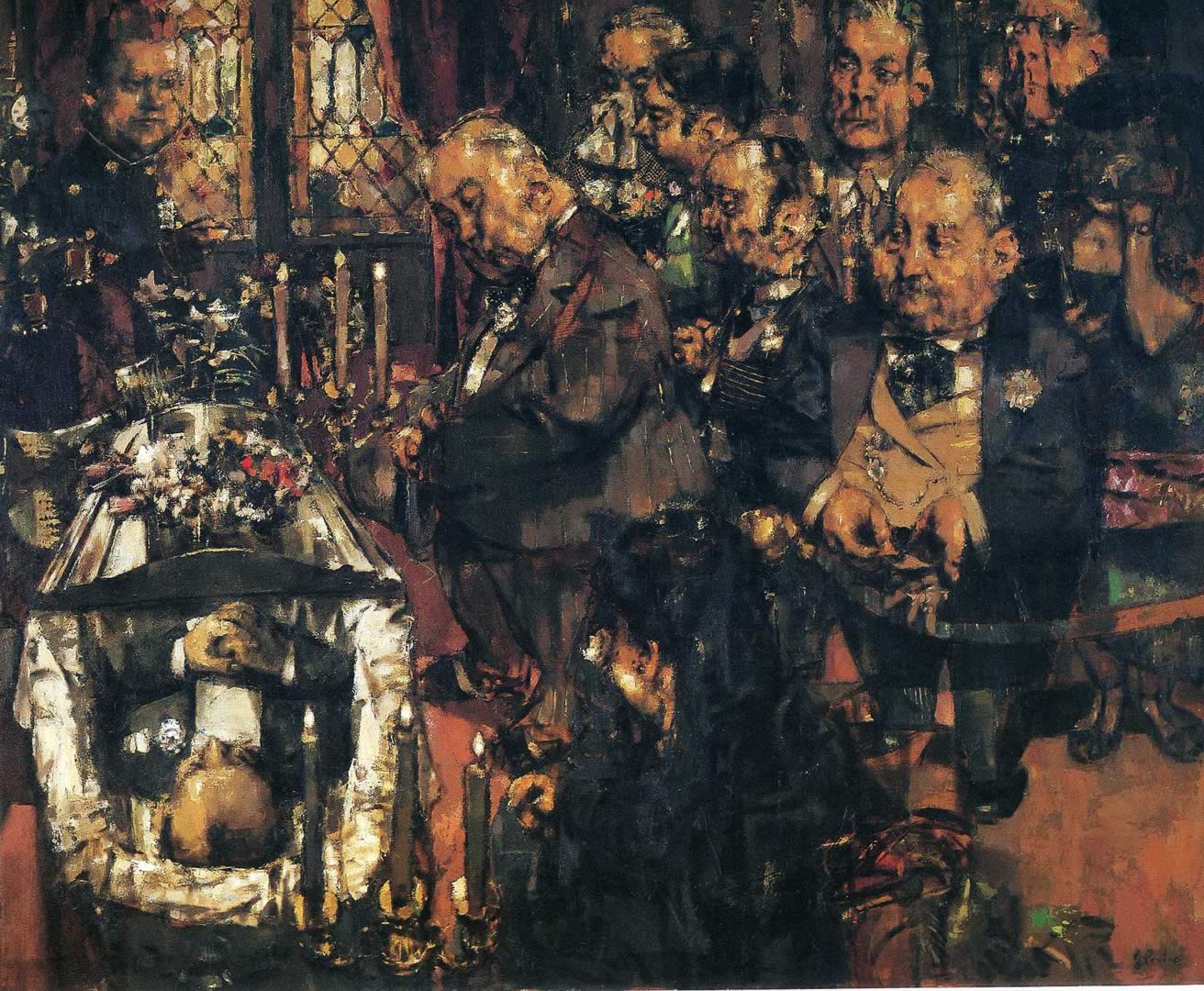
Does Dov Lipman want to outlaw flowers at funerals?
Dov Lipman has joined five of his colleagues from Yesh Atid, along with a smattering of kippa-clad MK's from other parties, in co-sponsoring a bill aimed at those who take advantage of mourners. The bill is in response to those who take advantage of mourners' fragile emotional state at a loved one's funeral to sell them amulets and other purportedly-magical baubles. According to the explanation accompanying the bill, people who lack a deep familiarity with Jewish Law may even think that there is a requirement to use such amulets.
 However, the law does more than outlaw the sale of amulets. It prohibits anyone, without the authorization of the Minister for Religious Services, from selling any item, asset, or service within a cemetery or within 100 meters of its entrance, unless the item, etc. is directly connected to funerary or burial services.
 But there's a bigger problem with the bill. It outlaws anything not directly related to the funeral or burial. Flowers? Factor out the bias of Western culture, and flowers are no more directly related to a funeral than amulets are. Sure, people often like to see flowers at a funeral, but, once the trinket-hockers have had their say, the same could be for amulets. Taxicabs? Sorry, unless the Minister for Religious Services thinks of authorizing them, you'll have to walk 100 meters from the cemetery to catch one. Car trouble near a cemetery? Unless you have a prepaid emergency roadside assistance, you can't pay someone for a tow.
 However, the law does more than outlaw the sale of amulets. It prohibits anyone, without the authorization of the Minister for Religious Services, from selling any item, asset, or service within a cemetery or within 100 meters of its entrance, unless the item, etc. is directly connected to funerary or burial services.
In other contexts, selling amulets is just preying on people's ignorance. In the context of
a cemetery, it's appalling. But I don't think the the practice should be outlawed - if for no other reason (and there are other reasons) than people hocking holy trinkets are not the only ones who take advantage of mourners - just the most tacky.
a cemetery, it's appalling. But I don't think the the practice should be outlawed - if for no other reason (and there are other reasons) than people hocking holy trinkets are not the only ones who take advantage of mourners - just the most tacky.
 But there's a bigger problem with the bill. It outlaws anything not directly related to the funeral or burial. Flowers? Factor out the bias of Western culture, and flowers are no more directly related to a funeral than amulets are. Sure, people often like to see flowers at a funeral, but, once the trinket-hockers have had their say, the same could be for amulets. Taxicabs? Sorry, unless the Minister for Religious Services thinks of authorizing them, you'll have to walk 100 meters from the cemetery to catch one. Car trouble near a cemetery? Unless you have a prepaid emergency roadside assistance, you can't pay someone for a tow.
What about cemeteries (such as the ones in Sanhedria, Bnei Brak, Petach Tikva, etc.) which are within city limits? Will stores and businesses which are within 100 meters from the entrances need to seek ministerial approval to stay open?
One thing I can't figure out: there's already a law which outlaws amulets - it's illegal to distribute them to convince people to vote (or to not vote). The relevant law actually uses the term "amulet", and defines it as including anything which part of the population believes has the power to do good or bad. If such a legal definition already exists, why didn't the authors of the bill just use the same language instead of making the bill so broad as to cover almost anything? I know that Yesh Atid MK's don't have a ton of experience as legislatures, but this is such a glaring oversight on their part, that they must have a hidden agenda. The explanation of the bill may refer to amulets, but, once it becomes law, the bill will be enforced based on its own language, which is pretty restrictive.
(BTW, this law only applies to Jewish cemeteries. Apparently fleecing Muslim or Christian mourners is still fine.)
An additional irony - the law against sales within cemeteries is designed to protect people in a fragile emotional state. However, the bill also contains an unrelated provision requiring authorized cemetery staff to wear an identification tag, so that mourners can easily distinguish them from those who seek to take advantage of them. So the bill is predicated on the assumption that people distraught/ignorant enough to believe in the necessity of amulets are composed/knowledgeable enough to know that they should only trust people wearing tags.
One thing I can't figure out: there's already a law which outlaws amulets - it's illegal to distribute them to convince people to vote (or to not vote). The relevant law actually uses the term "amulet", and defines it as including anything which part of the population believes has the power to do good or bad. If such a legal definition already exists, why didn't the authors of the bill just use the same language instead of making the bill so broad as to cover almost anything? I know that Yesh Atid MK's don't have a ton of experience as legislatures, but this is such a glaring oversight on their part, that they must have a hidden agenda. The explanation of the bill may refer to amulets, but, once it becomes law, the bill will be enforced based on its own language, which is pretty restrictive.
(BTW, this law only applies to Jewish cemeteries. Apparently fleecing Muslim or Christian mourners is still fine.)
An additional irony - the law against sales within cemeteries is designed to protect people in a fragile emotional state. However, the bill also contains an unrelated provision requiring authorized cemetery staff to wear an identification tag, so that mourners can easily distinguish them from those who seek to take advantage of them. So the bill is predicated on the assumption that people distraught/ignorant enough to believe in the necessity of amulets are composed/knowledgeable enough to know that they should only trust people wearing tags.
Thursday, December 5, 2013
All couples are equal, but some couples are more equal than others
MK Adi Kol (Yesh Atid) introduced a bill recently that was scheduled to be voted on today, granting same-sex couples the same rights mixed-sex couples enjoy vis-à-vis tax "points". Under the existing "point system", each person is assessed a number of points for different criteria (being a recent immigrant, having recently completed some higher education, having served in the army for a certain period, family status, etc.). For each point, a person receives a reduction in income tax, currently 218 shekel per month.
There is a difference in the amount of point given to fathers and mothers, with additional points being given to mothers, in order to encourage women with children to return to/enter the workforce. Besides the extra benefit given to mothers, women receive an extra half of a point (currently about 1,300 shekel per year) for the impressive accomplishment of having two X chromosomes in every last cell in her body, irrespective of the number of children she has, or even if she has any at all.
 According to Kol, same-sex couples of two men are treated unfairly under the current system, as they cannot take advantage of the additional tax points given to mothers, while same-sex couples of two women can "double-dip", with each one enjoying those extra points. In order to even things out, MK Kol proposed that one member of a same-sex couple will receive points as if s/he were a man, and the other as if s/he were a woman. The couple decides which one is which (George Costanza's philosophical conundrum of "how do you decide who leads" remains, tragically, unresolved).
At first glance, this seems like a fair law (despite Habayit Hayehudi's vigorous objection to it). There's no reason that, if the government gives a form of tax relief to a couple raising a child, it should only give it to mixed-gender ones. Once both parents are in the workforce, the extra money each month can go a long way towards defraying the necessary child-care expenses, irrespective of the genders of the parents.
However, in extending the tax break to same-sex couples, MK Kol is giving them an advantage that mixed-sex couples do not enjoy. Tax points are only valuable to someone who has an income; someone who does not pay income tax does not get the tax relief. In most mixed-sex, if, after the birth of a child, one spouse decides to give up working in favor of spending more time with the children (sometimes called "raising the children", but, from my experience, families with two working parents also raise the children, so I'll avoid the phrase in this context), it usually is the woman who does it, thereby giving up the tax relief the family would have received had she stayed in the workforce instead of the man. Whether this decision is due to social mores, biology, etc., is irrelevant. The bottom line is that in such cases, the additional tax benefit given to parents is forfeited if the mother does not return to work after a new child comes along.
However, same-sex couples are not so restricted by their physiology. If one of the spouses decides to give up working in favor of spending more time with their children, there is nothing stopping them from selecting the working spouse to receive the tax relief granted to women, even though he is assuming the typical "male" role.
If MK Kol really wanted to make all couples equal under the law, there are better ways to have done this. For example, she can extend the right to select who gets the extra tax points to all couples. Alternatively, she can change the way points are assigned, and instead of giving extra points to one of the spouses for his/her children, give it to a couple in which both spouses have an income (i.e., in a single-income family, points are given as they currently are given to a man; once the second spouse enters the workforce, the additional points are given, either to one of the spouses, or divided between the two).
Sunday, November 17, 2013
I am woman, hear me roar (or else)
Last week, a law, proposed by MK Yifat Kariv of Yesh Atid and which would penalize any party running for a local council that did not have a woman on at least every third spot on its list (Hebrew text here), passed its first reading in Knesset. Any party which is in violation will see a reduction in 15% in the amount of money they are given by the government.
The law comes to address the dismally small representation of women in municipal councils (as if men can't adequately represent women, especially when women do about half of the voting) by forcing parties to include them. (This is nothing like a parent or teacher forcing a bunch of kids play with a kid who feels left out, so don't even think about it.) Instead of coming up with creative ways of encouraging women to participate and excel in the political process, MK Kariv thought it better to jam her weltanschauung down the throats of local parties (figuratively speaking, although I'd pay good money to see someone literally jam a Weltanschauung down someone's throat).
Predictably, the Chareidi parties were against this, and MK Moshe Gafni attacked it (again, not exactly a galloping shock), saying that if this bill becomes law, people will henceforth assume that any woman given a slot on a list for a local election was not put their based on her own merit, but merely to fulfill a quota.
While Gafni may or may not be right, it's a bit of a childish argument; true, according to his logic, the result of the law could be somewhat ironic, but that's not a reason to oppose it. Notwithstanding, this is a bad bill, and would make a bad law, for several reasons (in no particular order, but the last one is my favorite). What follows is pretty long, but that's just how bad I think this bill is.
- It's sexist. The most obvious problem - the bill is biased in favor of women. It doesn't require that of every three candidates, at least one has to be of each gender. In theory, a party can discriminate against men, and not be in violation. This is more than just a hypothetical - such a party ran in the most recent elections in Elad. The bill seeks to penalize all-men's parties, but not all-women's ones. This is just asking for it to be struck down by the courts.
- Compliance could see women bumped down the list. The bill doesn't require that slots 1-3 need to have one woman, as do slots 4-6, 7-9, etc., but that every three consecutive slots have at least one woman ("בכל שלישיית מועמדים ברצף"; emphasis mine). In other words, you can't have more than two consecutive slots filled by men. Thus, slots 1-3 need to have a woman, as do slots 2-4, 3-6, 4-7, etc. A party which identifies five people, 4 men and 1 woman (as we'll see later, this is not an unlikely scenario), which it wants to run in its top five slots has only one option - to place the woman in the third slot. Placing her in either the first or second would require the party to place another woman, even one less qualified, in either the fourth or fifth slot, respectively, in order avoid having more than two consecutive slots filled by men. The bill thus creates an incentive to bump women from the first two slots on a list, in order to have more flexibility in slots 4 and 5. Similarly, if there are two highly qualified women, the bill makes it hard for a party to justify placing them both in the first three slots, since there's no allowance for having a lot of men lower down on the ticket if the top of the ticket has more women than required.
The really sad thing is that these twp issues could have been easily sidestepped had the bill been written better. The silver lining is that this could still be corrected, although I doubt that it will. But wait, there's more...
- It's de facto discriminatory, and seeks to weaken Chareidi parties. Well-established parties tend to give slots on their lists based on such factors as experience, seniority, and/or accomplishment. The ranks of Chareidi parties are full of men who are qualified based on the usual norms; not so much with suitable women. Whatever one thinks of this situation (the Chareidi party line is that their constituent women are not, by and large, interested in politics; their detractors find this line of reasoning to be cynical, patronizing, etc.), the fact remains that if the proposal becomes law, Chareidi parties will be at a particular disadvantage, as they will have to fill their slates with people who are less qualified (based on the usual norms) than they would like. Thus, this bill seeks to use the Knesset plenum to handicap certain parties in municipal elections. Not cool.
- It doesn't accomplish its stated goals (1). In the explanatory section of the bill, it states that women constitute 51% of the population, and in order to give them significant representation at the decision-making level, they need to be better represented in local councils. If that's the case, the bill should require that every second position be filled by a woman, and not just every third. To those who would argue that such a requirement would make a mockery of the electoral process, I say it's just a question of degree (or, as Churchill probably never said, "now we are haggling about the price").
- It doesn't accomplish its stated goals (2). In the explanatory section of the bill, it further states that it comes to address discrimination against people for reasons other than gender, for example because of religion, race, ethnicity, socioeconomic status, etc. You might think that there'd be some explanation as to how a bill which would increase the amount of women in municipal positions would also increase the amount of members of other discriminatory classes in such positions. If you think this, get used to disappointment. We're left to figure it out by ourselves, or, as I prefer, understand that the bill doesn't address this issue at all, and these other kinds of discrimination were mentioned for other reasons. Pure populism, maybe, or possible just the result of an automatic left-wing reflex. I think the intention is for us to use our imaginations on this one.
- It's (possibly) unnecessary government interference. The explanatory section of the law points to the low percentage of women in municipal government, but without a word of context. Is this figure higher or lower than it was after the last elections five years ago? What about 10, 15, or 20 years ago? What kind of trend do the numbers indicate? If it's one of increased participation of women, then this bill is not necessary at this point, since society is naturally going that way anyway. (For fans of big government, of course, this is not something against the bill; I'm just putting it out there for those who prefer small government.) There's even some anecdotal evidence that this particular "glass mechitza" is being broken in Chareidi society - for the first time, a Chareidi woman was elected to city council in Tzfat, and the Chareidi town of Elad saw the (very-late-in-the-game) formation of an all-woman's party.
- It's based on a mathematically flawed premise. According to the bill, there are 257 local councils. Let's say there are 1000 party lists (which would average between three and four parties running for each council in each municipality - this estimate is probably fairly low, but 1000 is a nice round number to work with). If each list would people based solely on their suitability for a position on their local council, with no regard to gender whatsoever, we would expect that 125 lists* would be in violation of the law. In fact, we would expect that about 15 parties would have lists with no women in the top 6 spots, by which point the law would require two women to have been given slots on a party's list. Of course, since there are far more than 1000 lists for municipal elections, we'd expect far more than 125 lists to be in violation of the law, just merely by chance. Besides being a strike against the bill, it's an indictment against the mathematical education the bill's backers received.
* A little mathematical explanation for those who need it on how I got to 125. You can either read it or take my word for it: 50% of parties would, just be chance, have a man in the first spot. Of those, 50% would have a man in the second spot, for 25% of lists having men in the first two spots. Of those, 50% would have a man in the third spot, for 12.5% of lists having men in the first three spots, just by chance.
Of course, this last point assumes that as many women as men want to be involved with local government. The numbers say otherwise. According to the bill, only 11% of positions on local councils are filled by women. But this number is country-wide, and includes local councils in heavily Chareidi towns. Looking at some large liberal cities (pretty much a random sampling of a few large ones, with Beersheva included for regional balance, and Modiin included since it's my hometown, plus it was designed as a secular city, with even the religious population being fairly politically liberal), the numbers are better, but only slightly (none of these figures include the male mayor):
- In Tel Aviv, 9 out of 30 municipal seats are filled by women.
- In Haifa, it's 5 out of 30.
- Rishon Letzion, which prides itself as being the first city with a female mayor, is about even with the national average with 3 out of 26.
- Beersheva is a bit better with 5 out of 26.
- Modiin, which has no Chareidi party in its local council, has 5 women out of 18 spots (the only religious party, Habayit Hayehudi, ran a woman in its second slot, and she made it to town council). In fact, the liberal anti-religious "Modiin Chofshit" party only managed to place 3 women on its slot of 10 candidates.
For these cities, only a hair above 20% of municipal council seats are held by women, which is almost twice the national average, but still paltry. Is this because an equal number of men and women vie for spots on municipal council, but the women are discriminated against one way or another at the party level? In places like Bnei Brak, Elad, or even Jerusalem, I could buy such an argument. But Tel Aviv? Modiin? Ridiculous.
For whatever reason, women as a group seem to be far less interested in running for municipal council than men are. (Side note - it's not just local councils - there are only 27 women serving in Knesset. Even discounting the 21 seats held by Chareidi parties, it's not much more than 25%.) So assuming that male office-seekers outnumber their female counterparts by 4 to 1, we'd expect that more than half of all parties would be in violation of the law if they chose candidates purely on their merits while completely ignoring gender. More than a quarter still wouldn't have a woman by the sixth slot, when the law would require them to have two. (If you don't want to trust me on the math, substitute 80% (0.8) for 50% in the little note above.) The law pushes parties to recruit people who are either under-qualified, under-motivated (which is worse, in my opinion), or both. Seriously not cool.
While I'm sure MK Kariv has her heart in the right place, she proposed a liberal bill that's sexist, discriminatory, misses its stated purpose, may smack of big government (which may be a plus for some people), and is based on ignorance of how to use numbers (which is hard to overlook in a bill which imposes a numerical regime on party-formation). Well done.
Thursday, October 31, 2013
What's really bothering MK Shafrir?
As part of Habayit Hayehudi's coalition agreement with Likud Beiteinu for the current government, a new "Jewish Identity Administration" is to be started. Earlier this week, the Finance Committee voted to fund it to the tune of 14 million shekel.
Freshman MK Stav Safrir opposed the funding, since the Administration would (might?) push a certain religious agenda. In her own (translated) words, "What is a Jewish identity, and who is authorized to define it?... It seems that someone is trying to promote a very specific agenda with public funds."
 While it's a fair point, we have no idea if Shafrir's main motivation is that she's against indoctrination (not her term, but close enough to what she was speaking against that I'll use it; please forgive the inexactness of it) of the public with a particular agenda, or if she just happens to be against that agenda, and sees no problem with indoctrination, or doesn't really think that the program is about indoctrination (the more likely option, given the relatively small budget of the program, i.e., only a few measly shekel per person, not nearly enough to indoctrinate even a small percentage of Israeli Jews).
A telling piece of information would be how she reacted to a similar case where she was either neutral or for a particular agenda, and see how she reacted there. Luckily, being Israeli politics, we don't have to look too far.
A while back, there was a proposal to cut funding which Yeshivot here get for each foreign student that attends. As Finance Minister, Lapid decided to restore that funding, with the caveat that the schools have to teach Zionism and civics to the students. (Hebrew article) Of course, there's not one kind of Zionism (and some Jews don't subscribe to any version): Wikipedia lists no fewer than six different types! This program certainly pushes a Zionist agenda, and may even demand that a certain kind of Zionist agenda be pushed.
So where was Shafrir when this item came up for discussion? With a 50 million shekel price tag, it has more than three times the budgetary impact as the Jewish Identity Administration, and it also promotes a very specific agenda.
Freshman MK Stav Safrir opposed the funding, since the Administration would (might?) push a certain religious agenda. In her own (translated) words, "What is a Jewish identity, and who is authorized to define it?... It seems that someone is trying to promote a very specific agenda with public funds."

A telling piece of information would be how she reacted to a similar case where she was either neutral or for a particular agenda, and see how she reacted there. Luckily, being Israeli politics, we don't have to look too far.
A while back, there was a proposal to cut funding which Yeshivot here get for each foreign student that attends. As Finance Minister, Lapid decided to restore that funding, with the caveat that the schools have to teach Zionism and civics to the students. (Hebrew article) Of course, there's not one kind of Zionism (and some Jews don't subscribe to any version): Wikipedia lists no fewer than six different types! This program certainly pushes a Zionist agenda, and may even demand that a certain kind of Zionist agenda be pushed.
So where was Shafrir when this item came up for discussion? With a 50 million shekel price tag, it has more than three times the budgetary impact as the Jewish Identity Administration, and it also promotes a very specific agenda.
Monday, October 21, 2013
Is the Netanyahu family the House of Nathan?
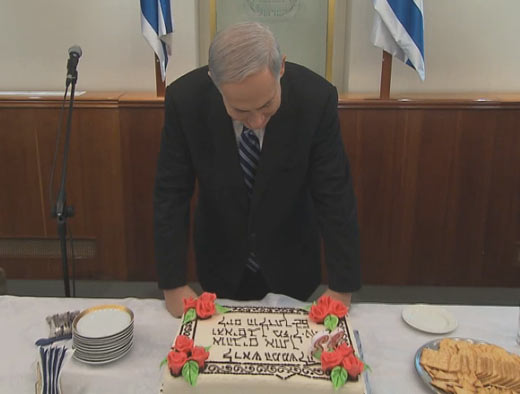 Just an random tidbit I came across yesterday, which I decided to share in honor of Bibi Netanyahu's 64th birthday.
In the 12th Perek of Zecharya, there's a prophecy about "the end of days", which includes the description of a funeral (of Mashiach ben Yosef, according to tradition). At the funeral (which is described, several times, as being gender-separated) representatives of Israel's leadership will deliver eulogies. The list of dignitaries includes the house of King David and the Levitical caste.
Besides these well-known dynasties, two families are mentioned by name. According to some commentators (such as Radak and Metzudat David - מצודת דוד), these families will exist and be well-known when the prophecy is fulfilled, and were not necessarily famous back then. One of them is בית נתן - the house of Nathan.
Of course, we don't know who the house of Nathan is. Is it possible that the Netanyahu family (whose name is based on the Hebrew version of Nathan, and whose patriarch was named Nathan) is the one referred to 2500 years ago? Anything's possible. Only time will tell.
In the meantime, happy birthday, Mr. Prime Minister!
----------------------------------------------------------------------------

The other family mentioned is the house of Shim'i. I have no idea who that could be. While you're pondering it, enjoy a picture of our president blowing out the candles on a birthday cake.
Thursday, October 17, 2013
Is Yesh Atid meant to be "Shinui 2.0"?
I don't know what made me think of it now, especially since Knesset elections have long since ended, and new ones are not (for now) anywhere on the horizon.
 Yair Lapid had a famous father. Not just famous, but infamous (not in-famous) among the religious crowd for his various anti-religious stances and statements. He took his anti-religious sentiments to the Knesset, under the banner of the שינוי (literally, "change") party.
Yair Lapid came to Knesset with a message that he is not following in his father's footsteps. Some of his best friends (or at least some of his party's slate) are not only religious, but ordained rabbis (one even claiming to be a Chareidi). Not everyone in the religious sector believes his claim. (I'm still undecided, but, admittedly, I'm not that interested in that particular aspect.)
But for some reason, the motto (official?/unofficial?) of his party is "באנו לשנות" ("We've come to change"). For someone as politically savvy as Yair Lapid, it's very close to the name which symbolized the legacy he claims to be running away from. Is he sending a subtle message to those who'd like to see him pick up where his father left off, that he'll continue the job (for example, the near-religious fervor he displayed in his quest to draft Chareidim), or is it just a coincidence?
I'm guessing that his supporters will point to statements he's made which support the case that he's not anti-religious/Chareidi, and his detractors will probably point out that he uses his substantial gift with words to sugar-coat his actions and hide his true intentions.
Thoughts?

Yair Lapid came to Knesset with a message that he is not following in his father's footsteps. Some of his best friends (or at least some of his party's slate) are not only religious, but ordained rabbis (one even claiming to be a Chareidi). Not everyone in the religious sector believes his claim. (I'm still undecided, but, admittedly, I'm not that interested in that particular aspect.)
But for some reason, the motto (official?/unofficial?) of his party is "באנו לשנות" ("We've come to change"). For someone as politically savvy as Yair Lapid, it's very close to the name which symbolized the legacy he claims to be running away from. Is he sending a subtle message to those who'd like to see him pick up where his father left off, that he'll continue the job (for example, the near-religious fervor he displayed in his quest to draft Chareidim), or is it just a coincidence?
I'm guessing that his supporters will point to statements he's made which support the case that he's not anti-religious/Chareidi, and his detractors will probably point out that he uses his substantial gift with words to sugar-coat his actions and hide his true intentions.
Thoughts?
Thursday, October 10, 2013
Want equality? You might just get what you asked for.
A petition has been filed by a Ruth Kolian, a law student from Petach Tikva* to deny state funding to political parties in Israel which exclude female candidates from their slates (I guess we can call them "political stag parties"). The parties named in the petition include the Ultra-Orthodox parties of Shas, United Torah Judaism, and Tov, which are each running all-male slates for local councils in various municipalities. (A link to the article is here; since the site is behind a paywall, the text is included below).
On the face of it, the petition seems fair - exclusionary tactics should have no place in an open society. While there probably are more Ultra-Orthodox men than women who are interested in participating in local politics, given the number of positions being sought, the parties should have no problem finding at least a few qualified and interested women.
Kolian, however, should be mindful of what Oscar Wilde wrote - "When the gods wish to punish us they answer our prayers". Denying state funding to political parties which exclude women would necessitate doing the same to political parties which include only women. Otherwise, not all parties would be equal before the law. In the Ultra-Orthodox city of Elad, a group of women have started a political party to run for city council. Not only is the party fielding an all-woman slate, its name ("עיר ואם" - "Mother and City"), slogan ("Mothers for the city of Elad"), and claimed political philosophy (women use city services more, they are thus better equipped to make decisions affecting those services) specifically exclude men.
I wish Kolian the best of luck. As a student, having to navigate the system she is studying will be a valuable experience. But if she's successful, she (and the women of עיר ואם in Elad) may learn a hard lesson in getting her way.
*or "Petah Tiqwa", for you purists.
-----------------------------------------------
Here's the article from Ha'aretz:
A social activist submitted a petition yesterday to the High Court of Justice, demanding that state funding be denied to political parties that exclude female candidates. The petition was filed just two weeks ahead of statewide local elections, scheduled for October 22.
In her petition, Ruth Kolian, an ultra-Orthodox law student from Petah Tikva, named as parties running in local elections that exclude women the ultra-Orthodox parties Shas; Degel Hatorah and Agudat Yisrael (which for national elections are united as United Torah Judaism) and Tov (which is competing in the municipal elections in Jerusalem, Elad and Modi'in Illit).
By barring women from running on their slates, Kolian writes in her petition, these parties violate the principle of equality and women’s rights, including the right of free expression.
Kolian herself announced several months ago that she intended to run for the Petah Tikva city council, but she never declared her candidacy and today is not a candidate for public office.
Granting state funds to parties that exclude women creates an "intolerable situation in which the excluded group finances the excluding one," she says, pointing out that female as well as male taxpayers help to fund the parties. This preserves "the well-oiled intimidation machine that is based on discrimination and exclusion."
By allowing parties that ban women from running while receiving funds from the state tacitly encourages and gives its approval to this practice, Kolian argues. “Banning women from joining these parties removes them from decision-making processes,” she writes.
Jerusalem city council member Laura Verton (Meretz) petitioned the Central Election Committee before the Knesset election earlier this year, demanding that Shas and UTJ be disqualified for refusing to include women on their slates.
In March Kolian walked from her Petah Tikva home to Jerusalem to protest the suspension of the public housing law. She is also a leading animal rights activist, whose actions have included demanding that the Eda Haredit slaughter board withhold kosher certification from meat whose preparation involved animal abuse.
On the face of it, the petition seems fair - exclusionary tactics should have no place in an open society. While there probably are more Ultra-Orthodox men than women who are interested in participating in local politics, given the number of positions being sought, the parties should have no problem finding at least a few qualified and interested women.
Kolian, however, should be mindful of what Oscar Wilde wrote - "When the gods wish to punish us they answer our prayers". Denying state funding to political parties which exclude women would necessitate doing the same to political parties which include only women. Otherwise, not all parties would be equal before the law. In the Ultra-Orthodox city of Elad, a group of women have started a political party to run for city council. Not only is the party fielding an all-woman slate, its name ("עיר ואם" - "Mother and City"), slogan ("Mothers for the city of Elad"), and claimed political philosophy (women use city services more, they are thus better equipped to make decisions affecting those services) specifically exclude men.
I wish Kolian the best of luck. As a student, having to navigate the system she is studying will be a valuable experience. But if she's successful, she (and the women of עיר ואם in Elad) may learn a hard lesson in getting her way.
*or "Petah Tiqwa", for you purists.
-----------------------------------------------
Here's the article from Ha'aretz:
A social activist submitted a petition yesterday to the High Court of Justice, demanding that state funding be denied to political parties that exclude female candidates. The petition was filed just two weeks ahead of statewide local elections, scheduled for October 22.
In her petition, Ruth Kolian, an ultra-Orthodox law student from Petah Tikva, named as parties running in local elections that exclude women the ultra-Orthodox parties Shas; Degel Hatorah and Agudat Yisrael (which for national elections are united as United Torah Judaism) and Tov (which is competing in the municipal elections in Jerusalem, Elad and Modi'in Illit).
By barring women from running on their slates, Kolian writes in her petition, these parties violate the principle of equality and women’s rights, including the right of free expression.
Kolian herself announced several months ago that she intended to run for the Petah Tikva city council, but she never declared her candidacy and today is not a candidate for public office.
Granting state funds to parties that exclude women creates an "intolerable situation in which the excluded group finances the excluding one," she says, pointing out that female as well as male taxpayers help to fund the parties. This preserves "the well-oiled intimidation machine that is based on discrimination and exclusion."
By allowing parties that ban women from running while receiving funds from the state tacitly encourages and gives its approval to this practice, Kolian argues. “Banning women from joining these parties removes them from decision-making processes,” she writes.
Jerusalem city council member Laura Verton (Meretz) petitioned the Central Election Committee before the Knesset election earlier this year, demanding that Shas and UTJ be disqualified for refusing to include women on their slates.
In March Kolian walked from her Petah Tikva home to Jerusalem to protest the suspension of the public housing law. She is also a leading animal rights activist, whose actions have included demanding that the Eda Haredit slaughter board withhold kosher certification from meat whose preparation involved animal abuse.
Sunday, September 29, 2013
Is Yeshiva University Insensitive to the Handicapped?
YU has been distributing its "To-Go"® series for some time. For those unfamiliar, it's a booklet published around each holiday, with articles relevant to the respective day. Some of the articles are better than others, but I usually find it to be, on the whole, a worthwhile read.
This past month, they put out a joint Rosh Hashana-Yom Kippur/Sukkot issue, with articles pertaining to the Tishrei holidays. One which I found particularly interesting was an article by Rabbi Kenneth Brander about the authorship of the "U'Netaneh Tokef" prayer, which is a highlight of the high holiday services.
The oft-repeated story is that Rav Amnon of Mainz composed this prayer about a thousand years ago, after his arms and legs were amputated by the local bishop as punishment for his refusal to convert to Christianity. On Rosh Hashana a few days after the punishment was carried out, Rav Amnon recited the "U'Netaneh Tokef" prayer in front of the congregation, before succumbing to his wounds.
The premise of the article is that Rav Amnon did not in fact compose the prayer. Rather, it was written much earlier by a composer named Yannai, who may have been the teacher of the famed Rav Elazar Hakalir. (For more info, follow the link above to the article.)
Rabbi Brander does a good job explaining the thesis, but I have to wonder about the title of the article. In short, he dispels a popular (apparent) misconception about the authorship of his important prayer, pointing out that it was not, as is widely though, written by a cripple. Maybe he could have found a less insensitive title than "U’Netaneh Tokef: Will the Real Author Please Stand Up"?
(I wrote this only half in jest. I'm sure that no offense was meant, but how did such a title get past the editors?)
This past month, they put out a joint Rosh Hashana-Yom Kippur/Sukkot issue, with articles pertaining to the Tishrei holidays. One which I found particularly interesting was an article by Rabbi Kenneth Brander about the authorship of the "U'Netaneh Tokef" prayer, which is a highlight of the high holiday services.
The oft-repeated story is that Rav Amnon of Mainz composed this prayer about a thousand years ago, after his arms and legs were amputated by the local bishop as punishment for his refusal to convert to Christianity. On Rosh Hashana a few days after the punishment was carried out, Rav Amnon recited the "U'Netaneh Tokef" prayer in front of the congregation, before succumbing to his wounds.
The premise of the article is that Rav Amnon did not in fact compose the prayer. Rather, it was written much earlier by a composer named Yannai, who may have been the teacher of the famed Rav Elazar Hakalir. (For more info, follow the link above to the article.)
Rabbi Brander does a good job explaining the thesis, but I have to wonder about the title of the article. In short, he dispels a popular (apparent) misconception about the authorship of his important prayer, pointing out that it was not, as is widely though, written by a cripple. Maybe he could have found a less insensitive title than "U’Netaneh Tokef: Will the Real Author Please Stand Up"?
(I wrote this only half in jest. I'm sure that no offense was meant, but how did such a title get past the editors?)
Tuesday, August 6, 2013
His father was a carpenter. Maybe his brother-in-law is a lawyer.
Dola Indidis, a Kenyan lawyer, is seeking to file suit at the International Court of Justice against Israel and Italy, for the execution of Jesus.


I don't know if the ICJ would allow the suit (although I have a pretty good idea), but even if they do, I'm not sure how Indidis could make his case, considering that the statute of limitations has probably passed, and all the witnesses are dead.
Despite the seeming absurdity of the charges, Israel should do everything it can to see that this case goes to trial. If the ICJ decides to hear the case, it would be an admission by them that, from a legal standpoint, Israel's presence in the land dates back at least almost 2,000 years, and that she is not merely a product of 20th century colonialism.
Sunday, July 21, 2013
The Frickin' Interjective
This is completely off-topic for this blog. I mean, not even close. So bear with me, and if you have any friends whom you think it may interest, feel free to pass it along.
As those who know me slowly get to realize, I'm something of a grammar freak. I read Eats, Shoots & Leaves for fun and actually enjoyed it (and found a mistake in it; not a typo, but a minor substance error), despite the lack of the Oxford comma in the title. On that note, I have strong feelings about the Oxford comma. (I'm for it. Strongly.)
Something about how grammar imparts structure and organization to language appeals to the engineer in me. (Ironically, surrounding my computer right now is somewhat of a holy mess of papers and other desk-related paraphernalia. I'd like to organize it, but the lazy-guy-in-me beats the engineer-in-me almost every time.)
With any good organizational system, everything has a function. Even better, when analyzed methodically, gaps, if any, in the system are unmistakable. I believe I have found one.
The interjection is used to express an emotion or sentiment on the part of the speaker. Syntactically, it's usually used by itself or at the beginning of a sentence. There are other parts of speech which may be used to give an indication of something about the speaker, including the ejaculation (which almost always stands on its own), the discourse marker, and the filler.
There is another way that words are used to express the emotion or sentiment of the speaker, but isn't, to my knowledge, recognized as an interjection. This is because it's hiding as an adjective. It comes before a noun or noun phrase, but doesn't modify it at all. Rather, it's used by the speaker to express an emotion, usually a negative one. Thus, it deserves its own, new part of speech.
What do I mean? I'm glad you #*@%-ing asked. Here's an example: You're eating dinner, and ask someone if he can pass you the rice. He says he can. You ask him if he will pass you the rice, he cleverly (to his mind, at least) says that he might if you ask. You then tell him to "pass the #*@% ing rice". The word preceding "rice", syntactically, is being used as an adjective would. However, it in no way is being used to describe the rice (if it is, I'd like that recipe), but as a reflection on your emotional state, as the speaker, toward your dinner-mate. In this case, it's justifiable, maybe borderline-homicidal, frustration.
(A neighbor of mine pointed out that sometimes it actually is an adjective, as in "damned rice", the implication being that you're taking you're frustration out on the food and expressing your desire for it to spend an eternity on Satan's buffet. I'll concede that sometimes this could be the case, but generally speaking, that's generally not true. Most times, other words are used, which indicate a gory state, as in the British "bloody", copulation, or nothing at all, as in "frickin'".)
Since it's somewhat of a cross between an interjection and an adjective, having the properties of the former, but being used syntactically as the latter is, I've come up with the portmanteau "interjective" for this new part of speech. Spread the word. It's gonna be a thing. A #*@%-ing thing.
Wednesday, July 17, 2013
Ruth Calderon, go to your room!
Last week, MK Ruth Calderon was skewered for suggesting that the Knesset install a makeup room so that female MKs can freshen up during the course of the day. Given the insignificance of her plan, it naturally became big news. Among other silliness, her party, "Yesh Atid" ("There is a future"), was referred to as "Yesh Ippur" ("There is makeup"). The Palestinian conflict and the Iranian threat took a backseat for a short while.
Some of the criticism came from other female MKs themselves. Their main point was that MKs are not putting on a show, and shouldn't focus too much on their appearances.
As a man, I tread very carefully when it comes to issues which affect the fairer sex, since I am, along with my fellow bearers of Y-chromosomes, a complete and bumbling moron when it comes to these matters. However, I don't understand the criticism. People, especially women, are judged based on their appearances. It's also possible (again, I'm going off the reservation here, so I apologize in advance if I'm wrong, which, as a man, I probably am) that (some) women aren't as confident when they feel that they need to re-powder their noses, or whatever else they need to do to freshen up. As unfair as it is, it's pretty well established that people perform better when they feel confident.
It's perfectly appropriate for female MKs to be as presentable as possible (some of the male MKs could do the same), since they'll be taken more seriously, and may actually perform better. It's not fair, but that's the way people are, and I think that even those who leveled criticism at her are aware of it (of course, the need to score points by making populist statements at someone else's expense can be a powerful temptation for some politicians).
However, I don't see the need for the Knesset to provide dedicated makeup rooms, as Calderon suggests, even if the MKs themselves are paying for the making-up. Among the amenities provided to MKs is an ensuite bathroom attached to their offices (sorry about the Hebrew; I couldn't find a suitable article in English). They should use the space given to them for freshening up their makeup when necessary, and not burden the Knesset budget to provide them with dedicated makeup rooms.
If Calderon feels the need to fix her makeup during the day, she should do so. But she should go to her room.
Some of the criticism came from other female MKs themselves. Their main point was that MKs are not putting on a show, and shouldn't focus too much on their appearances.
As a man, I tread very carefully when it comes to issues which affect the fairer sex, since I am, along with my fellow bearers of Y-chromosomes, a complete and bumbling moron when it comes to these matters. However, I don't understand the criticism. People, especially women, are judged based on their appearances. It's also possible (again, I'm going off the reservation here, so I apologize in advance if I'm wrong, which, as a man, I probably am) that (some) women aren't as confident when they feel that they need to re-powder their noses, or whatever else they need to do to freshen up. As unfair as it is, it's pretty well established that people perform better when they feel confident.
It's perfectly appropriate for female MKs to be as presentable as possible (some of the male MKs could do the same), since they'll be taken more seriously, and may actually perform better. It's not fair, but that's the way people are, and I think that even those who leveled criticism at her are aware of it (of course, the need to score points by making populist statements at someone else's expense can be a powerful temptation for some politicians).
However, I don't see the need for the Knesset to provide dedicated makeup rooms, as Calderon suggests, even if the MKs themselves are paying for the making-up. Among the amenities provided to MKs is an ensuite bathroom attached to their offices (sorry about the Hebrew; I couldn't find a suitable article in English). They should use the space given to them for freshening up their makeup when necessary, and not burden the Knesset budget to provide them with dedicated makeup rooms.
If Calderon feels the need to fix her makeup during the day, she should do so. But she should go to her room.
Nailed it - Nefesh B'Nefesh Uses My Idea
The Jewish Agency and (probably) Nefesh B'Nefesh have found a way to get around the strike in the Foreign Ministry to bring olim to Israel this summer. (The article doesn't mention NBN's involvement, but they are directly involved in all aspects of Aliyah, plus their website mentions that they are working with the Jewish Agency to find a solution to the problems caused by the strike. In addition, a friend of mine who works for them strongly suggested to me, while doing his best to not spill any beans, that they were involved as well.)
It's remarkably similar to the plan I suggested over two weeks ago on this blog. (OK, it's possible that they were working on this before I suggested it.)
Maybe next time they have a problem they should come to me first. :-)
It's remarkably similar to the plan I suggested over two weeks ago on this blog. (OK, it's possible that they were working on this before I suggested it.)
Maybe next time they have a problem they should come to me first. :-)
Thursday, July 4, 2013
Plastic Gun "Threatens" the Prime Minister
A TV crew from Channel 10 news printed a plastic gun, and managed to get it within a few meters of Bibi. The gun was manufactured with a 3-D printer, tested, and brought to Knesset, where it got past all security checks, including a metal detector. That 3-D printers can print a working gun based on plans easily available is not new, but reports of a gun made with the technology bypassing safeguards in a secure building are (do far) rare, AFAIK.
However, there's good reason to not be so alarmed about this.
Firstly, 3-D printing is a way of making something out of a plastic (or plastic-like) material. Such materials are hardly new. In the Clint Eastwood film In the Line of Fire, (spoiler alert; but seriously, the film is 20 years old) John Malkovich's protagonist manages to fire at the president using a gun he made out of plastic. Not only has plastic technology been around for many, many decades (remember the scene in The Graduate where Dustin Hoffman's character is advised to go into plastics?), but the idea of sneaking a plastic gun past security to assassinate a world leader hit the big screen 20 years ago. 3-D printing is not what got the gun past security, plastics did. Somehow, even with plastics easily available, and the idea of using a plastic gun to foil security being well-known for decades, we've haven't seen people successfully sneaking plastic guns into secure buildings and using them there.
Secondly, to misquote the bumper-sticker, guns don't kill people, bullets do. And, so far, they are made out of metal. Getting a gun to within 2 inches of a target won't help a would-be assassin unless he could somehow get the bullets there as well. (In fairness, they covered this in the movie as well, but I don't know how well a movie stratagem would work in real life.) As long as the Knesset still uses metal detectors, and as long as bullets are still made out of metal, I think we could breathe a little easier.
While the fact that a gun was smuggles into the Knesset, and got within firing range of Bibi, is disconcerting, bear in mind that it was done for dramatic effect, and doesn't necessarily mean that things are all of a sudden less safe than they were yesterday.
However, there's good reason to not be so alarmed about this.
Firstly, 3-D printing is a way of making something out of a plastic (or plastic-like) material. Such materials are hardly new. In the Clint Eastwood film In the Line of Fire, (spoiler alert; but seriously, the film is 20 years old) John Malkovich's protagonist manages to fire at the president using a gun he made out of plastic. Not only has plastic technology been around for many, many decades (remember the scene in The Graduate where Dustin Hoffman's character is advised to go into plastics?), but the idea of sneaking a plastic gun past security to assassinate a world leader hit the big screen 20 years ago. 3-D printing is not what got the gun past security, plastics did. Somehow, even with plastics easily available, and the idea of using a plastic gun to foil security being well-known for decades, we've haven't seen people successfully sneaking plastic guns into secure buildings and using them there.
Secondly, to misquote the bumper-sticker, guns don't kill people, bullets do. And, so far, they are made out of metal. Getting a gun to within 2 inches of a target won't help a would-be assassin unless he could somehow get the bullets there as well. (In fairness, they covered this in the movie as well, but I don't know how well a movie stratagem would work in real life.) As long as the Knesset still uses metal detectors, and as long as bullets are still made out of metal, I think we could breathe a little easier.
While the fact that a gun was smuggles into the Knesset, and got within firing range of Bibi, is disconcerting, bear in mind that it was done for dramatic effect, and doesn't necessarily mean that things are all of a sudden less safe than they were yesterday.
Saturday, June 29, 2013
Nefesh B'Nefesh Should Pull a Reagan on the Foreign Ministry
Every time there's a strike in Israel, which is pretty often, Americans get to reminiscing about how Reagan dealt with with air traffic controller strike in 1981 - he ordered the striking controllers back to work, and fired those who didn't do so within 48 hours. It's a nice fantasy to imagine something like that working in Israel, but I think that the culture and bureaucracy are too different from those in America for such a move to work and not backfire politically.
The current strike in the Foreign Ministry is unique, in that it's not just Israelis who are being affected. Visits by foreign leaders are being disrupted, and Aliyah visas are not being issued. The latter is affecting those who are planning to immigrate this summer. Nefesh B'Nefesh, which aids and helps process olim from North American and England, estimates that hundreds of potential olim will be affected if the strike is not resolved.
However, there is a simple solution to the problem. A strike can only work if the striking workers have the power to stop some service. Reagan showed that the striking air traffic controllers did not have this power by firing them and finding replacements. Nefesh B'Nefesh, as a representative of potential olim, can make a similar end-run around the Foreign Ministry.
There are two ways to make aliyah. One is to get an Aliyah visa from the Israeli Foreign Ministry while still in your country of origin, and obtain citizenship as you enter Israel. The other way works for those already in the country. You can go to the Interior Ministry in Israel (which, as far as I know, is not on strike), and they will process your Aliyah.
Instead of dealing with the Foreign Ministry, Nefesh B'Nefesh should go straight to the Interior Ministry here, and work with them to process the hundreds of people they will be bringing. These olim-to-be can fly to Israel on the planned charter or regular flights, enter the country as tourists (like any North American Brit does when they visit), and be immediately processed by Interior Ministry officials. So instead of entering the country as olim, they will enter as tourists, and then become olim a short while later.
There are some issues with this plan which would need to be addressed. The flights to Israel are payed for by the Jewish Agency. They have always (by always, I even mean pre-NBN) paid for the flight to Israel for anyone with an Aliyah visa (at least from the US; I don't know it this is true for olim from other countries). The Jewish Agency would have to be convinced to pay for the flights for planeloads of people who will enter as tourists and make Aliyah soon after their arrival. However, the Jewish Agency's head of Aliyah, Yehuda Sharf, told the Jerusalem Post that the agency "intends to do everything in its power to alleviate their problems". They may have reservations about the plan, but since they were going to pay for the flights anyway, overcoming them shouldn't be much of a hurdle.
I don't know what other issues may arise, including legal ones, but there's at least one member of Knesset who made Aliyah with Nefesh B'Nefesh's help. I imagine he's be more than willing to assist in any way he can.
The current strike in the Foreign Ministry is unique, in that it's not just Israelis who are being affected. Visits by foreign leaders are being disrupted, and Aliyah visas are not being issued. The latter is affecting those who are planning to immigrate this summer. Nefesh B'Nefesh, which aids and helps process olim from North American and England, estimates that hundreds of potential olim will be affected if the strike is not resolved.
However, there is a simple solution to the problem. A strike can only work if the striking workers have the power to stop some service. Reagan showed that the striking air traffic controllers did not have this power by firing them and finding replacements. Nefesh B'Nefesh, as a representative of potential olim, can make a similar end-run around the Foreign Ministry.
There are two ways to make aliyah. One is to get an Aliyah visa from the Israeli Foreign Ministry while still in your country of origin, and obtain citizenship as you enter Israel. The other way works for those already in the country. You can go to the Interior Ministry in Israel (which, as far as I know, is not on strike), and they will process your Aliyah.
Instead of dealing with the Foreign Ministry, Nefesh B'Nefesh should go straight to the Interior Ministry here, and work with them to process the hundreds of people they will be bringing. These olim-to-be can fly to Israel on the planned charter or regular flights, enter the country as tourists (like any North American Brit does when they visit), and be immediately processed by Interior Ministry officials. So instead of entering the country as olim, they will enter as tourists, and then become olim a short while later.
There are some issues with this plan which would need to be addressed. The flights to Israel are payed for by the Jewish Agency. They have always (by always, I even mean pre-NBN) paid for the flight to Israel for anyone with an Aliyah visa (at least from the US; I don't know it this is true for olim from other countries). The Jewish Agency would have to be convinced to pay for the flights for planeloads of people who will enter as tourists and make Aliyah soon after their arrival. However, the Jewish Agency's head of Aliyah, Yehuda Sharf, told the Jerusalem Post that the agency "intends to do everything in its power to alleviate their problems". They may have reservations about the plan, but since they were going to pay for the flights anyway, overcoming them shouldn't be much of a hurdle.
I don't know what other issues may arise, including legal ones, but there's at least one member of Knesset who made Aliyah with Nefesh B'Nefesh's help. I imagine he's be more than willing to assist in any way he can.
Subscribe to:
Posts (Atom)