Tuesday, December 10, 2013

Does Dov Lipman want to outlaw flowers at funerals?

Dov Lipman has joined five of his colleagues from Yesh Atid, along with a smattering of kippa-clad MK's from other parties, in co-sponsoring a bill aimed at those who take advantage of mourners. The bill is in response to those who take advantage of mourners' fragile emotional state at a loved one's funeral to sell them amulets and other purportedly-magical baubles. According to the explanation accompanying the bill, people who lack a deep familiarity with Jewish Law may even think that there is a requirement to use such amulets.

However, the law does more than outlaw the sale of amulets. It prohibits anyone, without the authorization of the Minister for Religious Services, from selling any item, asset, or service within a cemetery or within 100 meters of its entrance, unless the item, etc. is directly connected to funerary or burial services.

In other contexts, selling amulets is just preying on people's ignorance. In the context of
a cemetery, it's appalling. But I don't think the the practice should be outlawed - if for no other reason (and there are other reasons) than people hocking holy trinkets are not the only ones who take advantage of mourners - just the most tacky.

But there's a bigger problem with the bill. It outlaws anything not directly related to the funeral or burial. Flowers? Factor out the bias of Western culture, and flowers are no more directly related to a funeral than amulets are. Sure, people often like to see flowers at a funeral, but, once the trinket-hockers have had their say, the same could be for amulets. Taxicabs? Sorry, unless the Minister for Religious Services thinks of authorizing them, you'll have to walk 100 meters from the cemetery to catch one. Car trouble near a cemetery? Unless you have a prepaid emergency roadside assistance, you can't pay someone for a tow. 

What about cemeteries (such as the ones in Sanhedria, Bnei Brak, Petach Tikva, etc.) which are within city limits? Will stores and businesses which are within 100 meters from the entrances need to seek ministerial approval to stay open?

One thing I can't figure out: there's already a law which outlaws amulets - it's illegal to distribute them to convince people to vote (or to not vote). The relevant law actually uses the term "amulet", and defines it as including anything which part of the population believes has the power to do good or bad. If such a legal definition already exists, why didn't the authors of the bill just use the same language instead of making the bill so broad as to cover almost anything? I know that Yesh Atid MK's don't have a ton of experience as legislatures, but this is such a glaring oversight on their part, that they must have a hidden agenda. The explanation of the bill may refer to amulets, but, once it becomes law, the bill will be enforced based on its own language, which is pretty restrictive.

(BTW, this law only applies to Jewish cemeteries. Apparently fleecing Muslim or Christian mourners is still fine.)

An additional irony - the law against sales within cemeteries is designed to protect people in a fragile emotional state. However, the bill also contains an unrelated provision requiring authorized cemetery staff to wear an identification tag, so that mourners can easily distinguish them from those who seek to take advantage of them. So the bill is predicated on the assumption that people distraught/ignorant enough to believe in the necessity of amulets are composed/knowledgeable enough to know that they should only trust people wearing tags.

Thursday, December 5, 2013

All couples are equal, but some couples are more equal than others

MK Adi Kol (Yesh Atid) introduced a bill recently that was scheduled to be voted on today, granting same-sex couples the same rights mixed-sex couples enjoy vis-à-vis tax "points". Under the existing "point system", each person is assessed a number of points for different criteria (being a recent immigrant, having recently completed some higher education, having served in the army for a certain period, family status, etc.). For each point, a person receives a reduction in income tax, currently 218 shekel per month.

There is a difference in the amount of point given to fathers and mothers, with additional points being given to mothers, in order to encourage women with children to return to/enter the workforce. Besides the extra benefit given to mothers, women receive an extra half of a point (currently about 1,300 shekel per year) for the impressive accomplishment of having two X chromosomes in every last cell in her body, irrespective of the number of children she has, or even if she has any at all.


According to Kol, same-sex couples of two men are treated unfairly under the current system, as they cannot take advantage of the additional tax points given to mothers, while same-sex couples of two women can "double-dip", with each one enjoying those extra points. In order to even things out, MK Kol proposed that one member of a same-sex couple will receive points as if s/he were a man, and the other as if s/he were a woman. The couple decides which one is which (George Costanza's philosophical conundrum of "how do you decide who leads" remains, tragically, unresolved).


At first glance, this seems like a fair law (despite Habayit Hayehudi's vigorous objection to it). There's no reason that, if the government gives a form of tax relief to a couple raising a child, it should only give it to mixed-gender ones. Once both parents are in the workforce, the extra money each month can go a long way towards defraying the necessary child-care expenses, irrespective of the genders of the parents.

However, in extending the tax break to same-sex couples, MK Kol is giving them an advantage that mixed-sex couples do not enjoy. Tax points are only valuable to someone who has an income; someone who does not pay income tax does not get the tax relief. In most mixed-sex, if, after the birth of a child, one spouse decides to give up working in favor of spending more time with the children (sometimes called "raising the children", but, from my experience, families with two working parents also raise the children, so I'll avoid the phrase in this context), it usually is the woman who does it, thereby giving up the tax relief the family would have received had she stayed in the workforce instead of the man. Whether this decision is due to social mores, biology, etc., is irrelevant. The bottom line is that in such cases, the additional tax benefit given to parents is forfeited if the mother does not return to work after a new child comes along.

However, same-sex couples are not so restricted by their physiology. If one of the spouses decides to give up working in favor of spending more time with their children, there is nothing stopping them from selecting the working spouse to receive the tax relief granted to women, even though he is assuming the typical "male" role.

If MK Kol really wanted to make all couples equal under the law, there are better ways to have done this. For example, she can extend the right to select who gets the extra tax points to all couples. Alternatively, she can change the way points are assigned, and instead of giving extra points to one of the spouses for his/her children, give it to a couple in which both spouses have an income (i.e., in a single-income family, points are given as they currently are given to a man; once the second spouse enters the workforce, the additional points are given, either to one of the spouses, or divided between the two).

Sunday, November 17, 2013

I am woman, hear me roar (or else)

Last week, a law, proposed by MK Yifat Kariv of Yesh Atid and which would penalize any party running for a local council that did not have a woman on at least every third spot on its list (Hebrew text here), passed its first reading in Knesset. Any party which is in violation will see a reduction in 15% in the amount of money they are given by the government.

The law comes to address the dismally small representation of women in municipal councils (as if men can't adequately represent women, especially when women do about half of the voting) by forcing parties to include them. (This is nothing like a parent or teacher forcing a bunch of kids play with a kid who feels left out, so don't even think about it.) Instead of coming up with creative ways of encouraging women to participate and excel in the political process, MK Kariv thought it better to jam her weltanschauung down the throats of local parties (figuratively speaking, although I'd pay good money to see someone literally jam a Weltanschauung down someone's throat).

Predictably, the Chareidi parties were against this, and MK Moshe Gafni attacked it (again, not exactly a galloping shock), saying that if this bill becomes law, people will henceforth assume that any woman given a slot on a list for a local election was not put their based on her own merit, but merely to fulfill a quota.

While Gafni may or may not be right, it's a bit of a childish argument; true, according to his logic, the result of the law could be somewhat ironic, but that's not a reason to oppose it. Notwithstanding, this is a bad bill, and would make a bad law, for several reasons (in no particular order, but the last one is my favorite). What follows is pretty long, but that's just how bad I think this bill is.
  • It's sexist. The most obvious problem - the bill is biased in favor of women. It doesn't require that of every three candidates, at least one has to be of each gender. In theory, a party can discriminate against men, and not be in violation. This is more than just a hypothetical - such a party ran in the most recent elections in Elad. The bill seeks to penalize all-men's parties, but not all-women's ones. This is just asking for it to be struck down by the courts.
  • Compliance could see women bumped down the list. The bill doesn't require that slots 1-3 need to have one woman, as do slots 4-6, 7-9, etc., but that every three consecutive slots have at least one woman ("בכל שלישיית מועמדים ברצף"; emphasis mine). In other words, you can't have more than two consecutive slots filled by men. Thus, slots 1-3 need to have a woman, as do slots 2-4, 3-6, 4-7, etc. A party which identifies five people, 4 men and 1 woman (as we'll see later, this is not an unlikely scenario), which it wants to run in its top five slots has only one option - to place the woman in the third slot. Placing her in either the first or second would require the party to place another woman, even one less qualified, in either the fourth or fifth slot, respectively, in order avoid having more than two consecutive slots filled by men. The bill thus creates an incentive to bump women from the first two slots on a list, in order to have more flexibility in slots 4 and 5. Similarly, if there are two highly qualified women, the bill makes it hard for a party to justify placing them both in the first three slots, since there's no allowance for having a lot of men lower down on the ticket if the top of the ticket has more women than required.
The really sad thing is that these twp issues could have been easily sidestepped had the bill been written better. The silver lining is that this could still be corrected, although I doubt that it will. But wait, there's more...
  • It's de facto discriminatory, and seeks to weaken Chareidi parties. Well-established parties tend to give slots on their lists based on such factors as experience, seniority, and/or accomplishment. The ranks of Chareidi parties are full of men who are qualified based on the usual norms; not so much with suitable women. Whatever one thinks of this situation (the Chareidi party line is that their constituent women are not, by and large, interested in politics; their detractors find this line of reasoning to be cynical, patronizing, etc.), the fact remains that if the proposal becomes law, Chareidi parties will be at a particular disadvantage, as they will have to fill their slates with people who are less qualified (based on the usual norms) than they would like. Thus, this bill seeks to use the Knesset plenum to handicap certain parties in municipal elections. Not cool.
  • It doesn't accomplish its stated goals (1). In the explanatory section of the bill, it states that women constitute 51% of the population, and in order to give them significant representation at the decision-making level, they need to be better represented in local councils. If that's the case, the bill should require that every second position be filled by a woman, and not just every third. To those who would argue that such a requirement would make a mockery of the electoral process, I say it's just a question of degree (or, as Churchill probably never said, "now we are haggling about the price").
  • It doesn't accomplish its stated goals (2). In the explanatory section of the bill, it further states that it comes to address discrimination against people for reasons other than gender, for example because of religion, race, ethnicity, socioeconomic status, etc. You might think that there'd be some explanation as to how a bill which would increase the amount of women in municipal positions would also increase the amount of members of other discriminatory classes in such positions. If you think this, get used to disappointment. We're left to figure it out by ourselves, or, as I prefer, understand that the bill doesn't address this issue at all, and these other kinds of discrimination were mentioned for other reasons. Pure populism, maybe, or possible just the result of an automatic left-wing reflex. I think the intention is for us to use our imaginations on this one.
  • It's (possibly) unnecessary government interference. The explanatory section of the law points to the low percentage of women in municipal government, but without a word of context. Is this figure higher or lower than it was after the last elections five years ago? What about 10, 15, or 20 years ago? What kind of trend do the numbers indicate? If it's one of increased participation of women, then this bill is not necessary at this point, since society is naturally going that way anyway. (For fans of big government, of course, this is not something against the bill; I'm just putting it out there for those who prefer small government.) There's even some anecdotal evidence that this particular "glass mechitza" is being broken in Chareidi society - for the first time, a Chareidi woman was elected to city council in Tzfat, and the Chareidi town of Elad saw the (very-late-in-the-game) formation of an all-woman's party.
  • It's based on a mathematically flawed premise. According to the bill, there are 257 local councils. Let's say there are 1000 party lists (which would average between three and four parties running for each council in each municipality - this estimate is probably fairly low, but 1000 is a nice round number to work with). If each list would people based solely on their suitability for a position on their local council, with no regard to gender whatsoever, we would expect that 125 lists* would be in violation of the law. In fact, we would expect that about 15 parties would have lists with no women in the top 6 spots, by which point the law would require two women to have been given slots on a party's list. Of course, since there are far more than 1000 lists for municipal elections, we'd expect far more than 125 lists to be in violation of the law, just merely by chance. Besides being a strike against the bill, it's an indictment against the mathematical education the bill's backers received.
* A little mathematical explanation for those who need it on how I got to 125. You can either read it or take my word for it: 50% of parties would, just be chance, have a man in the first spot. Of those, 50% would have a man in the second spot, for 25% of lists having men in the first two spots. Of those, 50% would have a man in the third spot, for 12.5% of lists having men in the first three spots, just by chance.

Of course, this last point assumes that as many women as men want to be involved with local government. The numbers say otherwise. According to the bill, only 11% of positions on local councils are filled by women. But this number is country-wide, and includes local councils in heavily Chareidi towns. Looking at some large liberal cities (pretty much a random sampling of a few large ones, with Beersheva included for regional balance, and Modiin included since it's my hometown, plus it was designed as a secular city, with even the religious population being fairly politically liberal), the numbers are better, but only slightly (none of these figures include the male mayor):
  • In Tel Aviv, 9 out of 30 municipal seats are filled by women.
  • In Haifa, it's 5 out of 30.
  • Rishon Letzion, which prides itself as being the first city with a female mayor, is about even with the national average with 3 out of 26.
  • Beersheva is a bit better with 5 out of 26.
  • Modiin, which has no Chareidi party in its local council, has 5 women out of 18 spots (the only religious party, Habayit Hayehudi, ran a woman in its second slot, and she made it to town council). In fact, the liberal anti-religious "Modiin Chofshit" party only managed to place 3 women on its slot of 10 candidates.
For these cities, only a hair above 20% of municipal council seats are held by women, which is almost twice the national average, but still paltry. Is this because an equal number of men and women vie for spots on municipal council, but the women are discriminated against one way or another at the party level? In places like Bnei Brak, Elad, or even Jerusalem, I could buy such an argument. But Tel Aviv? Modiin? Ridiculous.

For whatever reason, women as a group seem to be far less interested in running for municipal council than men are. (Side note - it's not just local councils - there are only 27 women serving in Knesset. Even discounting the 21 seats held by Chareidi parties, it's not much more than 25%.) So assuming that male office-seekers outnumber their female counterparts by 4 to 1, we'd expect that more than half of all parties would be in violation of the law if they chose candidates purely on their merits while completely ignoring gender. More than a quarter still wouldn't have a woman by the sixth slot, when the law would require them to have two. (If you don't want to trust me on the math, substitute 80% (0.8) for 50% in the little note above.) The law pushes parties to recruit people who are either under-qualified, under-motivated (which is worse, in my opinion), or both. Seriously not cool.

While I'm sure MK Kariv has her heart in the right place, she proposed a liberal bill that's sexist, discriminatory, misses its stated purpose, may smack of big government (which may be a plus for some people), and is based on ignorance of how to use numbers (which is hard to overlook in a bill which imposes a numerical regime on party-formation). Well done.

Thursday, October 31, 2013

What's really bothering MK Shafrir?

As part of Habayit Hayehudi's coalition agreement with Likud Beiteinu for the current government, a new "Jewish Identity Administration" is to be started. Earlier this week, the Finance Committee voted to fund it to the tune of 14 million shekel.

Freshman MK Stav Safrir opposed the funding, since the Administration would (might?) push a certain religious agenda. In her own (translated) words, "What is a Jewish identity, and who is authorized to define it?... It seems that someone is trying to promote a very specific agenda with public funds."

While it's a fair point, we have no idea if Shafrir's main motivation is that she's against indoctrination (not her term, but close enough to what she was speaking against that I'll use it; please forgive the inexactness of it) of the public with a particular agenda, or if she just happens to be against that agenda, and sees no problem with indoctrination, or doesn't really think that the program is about indoctrination (the more likely option, given the relatively small budget of the program, i.e., only a few measly shekel per person, not nearly enough to indoctrinate even a small percentage of Israeli Jews).

A telling piece of information would be how she reacted to a similar case where she was either neutral or for a particular agenda, and see how she reacted there. Luckily, being Israeli politics, we don't have to look too far.

A while back, there was a proposal to cut funding which Yeshivot here get for each foreign student that attends. As Finance Minister, Lapid decided to restore that funding, with the caveat that the schools have to teach Zionism and civics to the students. (Hebrew article) Of course, there's not one kind of Zionism (and some Jews don't subscribe to any version): Wikipedia lists no fewer than six different types! This program certainly pushes a Zionist agenda, and may even demand that a certain kind of Zionist agenda be pushed.

So where was Shafrir when this item came up for discussion? With a 50 million shekel price tag, it has more than three times the budgetary impact as the Jewish Identity Administration, and it also promotes a very specific agenda.

Monday, October 21, 2013

Is the Netanyahu family the House of Nathan?

Just an random tidbit I came across yesterday, which I decided to share in honor of Bibi Netanyahu's 64th birthday.

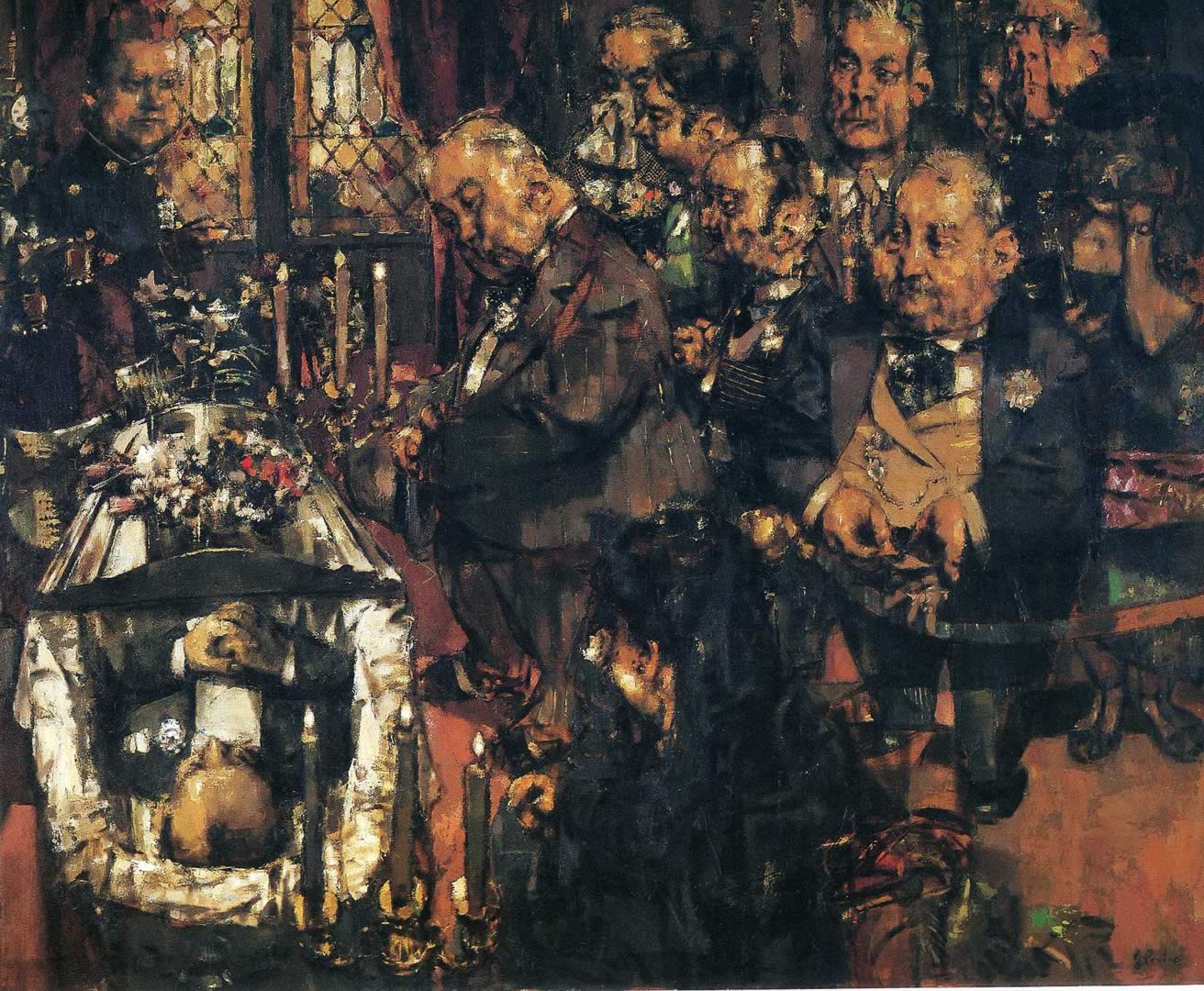
In the 12th Perek of Zecharya, there's a prophecy about "the end of days", which includes the description of a funeral (of Mashiach ben Yosef, according to tradition). At the funeral (which is described, several times, as being gender-separated) representatives of Israel's leadership will deliver eulogies. The list of dignitaries includes the house of King David and the Levitical caste.

Besides these well-known dynasties, two families are mentioned by name. According to some commentators (such as Radak and Metzudat David - מצודת דוד), these families will exist and be well-known when the prophecy is fulfilled, and were not necessarily famous back then. One of them is בית נתן - the house of Nathan.

Of course, we don't know who the house of Nathan is. Is it possible that the Netanyahu family (whose name is based on the Hebrew version of Nathan, and whose patriarch was named Nathan) is the one referred to 2500 years ago? Anything's possible. Only time will tell.

In the meantime, happy birthday, Mr. Prime Minister!

----------------------------------------------------------------------------


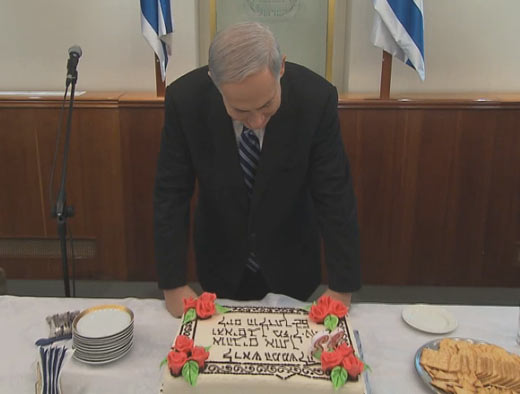
The other family mentioned is the house of Shim'i. I have no idea who that could be. While you're pondering it, enjoy a picture of our president blowing out the candles on a birthday cake.

Thursday, October 17, 2013

Is Yesh Atid meant to be "Shinui 2.0"?

I don't know what made me think of it now, especially since Knesset elections have long since ended, and new ones are not (for now) anywhere on the horizon.

Yair Lapid had a famous father. Not just famous, but infamous (not in-famous) among the religious crowd for his various anti-religious stances and statements. He took his anti-religious sentiments to the Knesset, under the banner of the שינוי (literally, "change") party.

Yair Lapid came to Knesset with a message that he is not following in his father's footsteps. Some of his best friends (or at least some of his party's slate) are not only religious, but ordained rabbis (one even claiming to be a Chareidi). Not everyone in the religious sector believes his claim. (I'm still undecided, but, admittedly, I'm not that interested in that particular aspect.)

But for some reason, the motto (official?/unofficial?) of his party is "באנו לשנות" ("We've come to change"). For someone as politically savvy as Yair Lapid, it's very close to the name which symbolized the legacy he claims to be running away from. Is he sending a subtle message to those who'd like to see him pick up where his father left off, that he'll continue the job (for example, the near-religious fervor he displayed in his quest to draft Chareidim), or is it just a coincidence?

I'm guessing that his supporters will point to statements he's made which support the case that he's not anti-religious/Chareidi, and his detractors will probably point out that he uses his substantial gift with words to sugar-coat his actions and hide his true intentions.

Thoughts?

Thursday, October 10, 2013

Want equality? You might just get what you asked for.

A petition has been filed by a Ruth Kolian, a law student from Petach Tikva* to deny state funding to political parties in Israel which exclude female candidates from their slates (I guess we can call them "political stag parties"). The parties named in the petition include the Ultra-Orthodox parties of Shas, United Torah Judaism, and Tov, which are each running all-male slates for local councils in various municipalities. (A link to the article is here; since the site is behind a paywall, the text is included below).

On the face of it, the petition seems fair - exclusionary tactics should have no place in an open society. While there probably are more Ultra-Orthodox men than women who are interested in participating in local politics, given the number of positions being sought, the parties should have no problem finding at least a few qualified and interested women.

Kolian, however, should be mindful of what Oscar Wilde wrote - "When the gods wish to punish us they answer our prayers". Denying state funding to political parties which exclude women would necessitate doing the same to political parties which include only women. Otherwise, not all parties would be equal before the law. In the Ultra-Orthodox city of Elad, a group of women have started a political party to run for city council. Not only is the party fielding an all-woman slate, its name ("עיר ואם" - "Mother and City"), slogan ("Mothers for the city of Elad"), and claimed political philosophy (women use city services more, they are thus better equipped to make decisions affecting those services) specifically exclude men.

I wish Kolian the best of luck. As a student, having to navigate the system she is studying will be a valuable experience. But if she's successful, she (and the women of עיר ואם in Elad) may learn a hard lesson in getting her way.


*or "Petah Tiqwa", for you purists.


-----------------------------------------------
Here's the article from Ha'aretz:

A social activist submitted a petition yesterday to the High Court of Justice, demanding that state funding be denied to political parties that exclude female candidates. The petition was filed just two weeks ahead of statewide local elections, scheduled for October 22.

In her petition, Ruth Kolian, an ultra-Orthodox law student from Petah Tikva, named as parties running in local elections that exclude women the ultra-Orthodox parties Shas; Degel Hatorah and Agudat Yisrael (which for national elections are united as United Torah Judaism) and Tov (which is competing in the municipal elections in Jerusalem, Elad and Modi'in Illit).

By barring women from running on their slates, Kolian writes in her petition, these parties violate the principle of equality and women’s rights, including the right of free expression.

Kolian herself announced several months ago that she intended to run for the Petah Tikva city council, but she never declared her candidacy and today is not a candidate for public office.

Granting state funds to parties that exclude women creates an "intolerable situation in which the excluded group finances the excluding one," she says, pointing out that female as well as male taxpayers help to fund the parties. This preserves "the well-oiled intimidation machine that is based on discrimination and exclusion."

By allowing parties that ban women from running while receiving funds from the state tacitly encourages and gives its approval to this practice, Kolian argues. “Banning women from joining these parties removes them from decision-making processes,” she writes.

Jerusalem city council member Laura Verton (Meretz) petitioned the Central Election Committee before the Knesset election earlier this year, demanding that Shas and UTJ be disqualified for refusing to include women on their slates.

In March Kolian walked from her Petah Tikva home to Jerusalem to protest the suspension of the public housing law. She is also a leading animal rights activist, whose actions have included demanding that the Eda Haredit slaughter board withhold kosher certification from meat whose preparation involved animal abuse.